Sole architect and full-stack engineer · 2025
A personalized learning platform that grows a mind map from what you read
Outcome: An AI content-ingestion pipeline turns ad-hoc web reading into a structured knowledge base and an automatically generated mind map of everything you've learned.
A full-stack AI platform where users capture content through a browser extension, a Step Functions pipeline extracts structured knowledge with LLMs, and every ingestion grows an auto-generated mind map — a living visual graph of topics and relationships that reflects the user's knowledge as it accumulates.
The problem
People read constantly — articles, papers, docs — and almost none of it gets captured in a form they can navigate later. I wanted a system that turns unstructured reading into something you can actually see: a mind map of topics and relationships that grows automatically as you ingest content, so the shape of your own knowledge becomes visible and navigable over time.
That meant three hard problems in one:
- An ingestion surface the user barely has to think about (a browser extension, not a form).
- An AI pipeline that reliably extracts, classifies, and organizes knowledge — with enough guardrails that the mind map stays coherent at scale.
- A data layer that keeps relational truth (content, sources, subscriptions) and graph truth (topic hierarchy, relationships) in sync so the map reflects the library.
Architecture
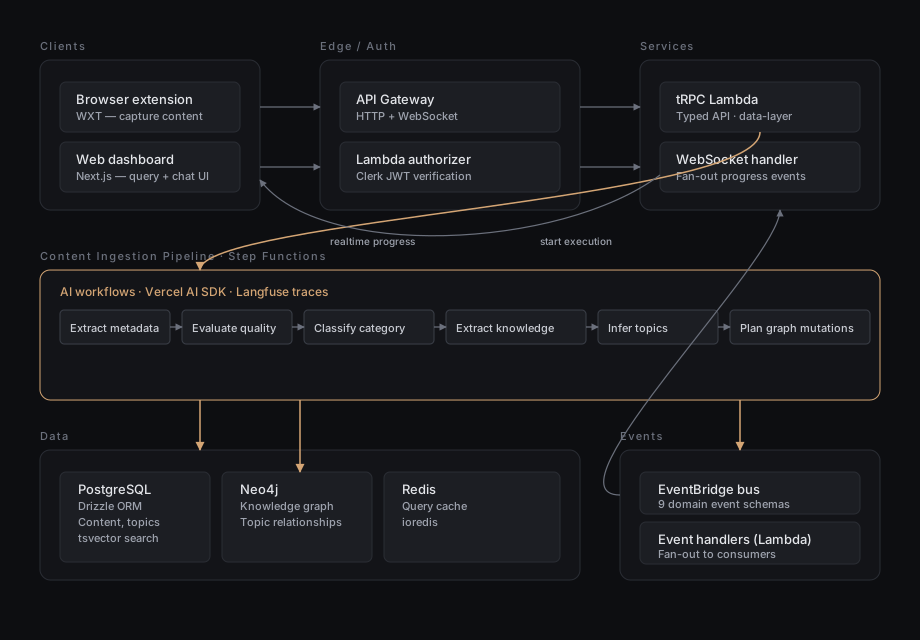
The system is a Turborepo monorepo with four apps and seven packages. The interesting shape is the split between write path (Step Functions pipeline mutating both PostgreSQL and Neo4j, incrementally growing the mind map with each ingestion) and read path (tRPC Lambda reading cached + aggregated data for the dashboard’s views of the knowledge base and mind map), with EventBridge connecting the two and a WebSocket API pushing real-time progress back to the dashboard while content is being processed.
Key decisions
Step Functions for the ingestion pipeline
Content processing is a chain of AI workflows: extract metadata → evaluate quality → classify review category → extract knowledge → extract topics → infer topic parents → plan graph mutations → score relevancy. Each step can fail independently, each has different compute and cost profiles, and the happy path is long.
Step Functions was the right fit because:
- Each AI call gets its own isolated retry / timeout / error branch.
- Per-execution history is observable without extra tooling.
- Steps can fan out where the work allows (topic inference across many knowledge fragments in parallel).
Running this as a single long-running Lambda would have traded clarity for a deployment footprint I didn’t need.
PostgreSQL for content, Neo4j for the mind map
The core relational data — content, content-sources, contexts, topics, subscriptions — lives in PostgreSQL (Drizzle ORM, with tsvector for full-text search). The mind map — topic parent relationships, topic-to-fragment links, and the graph mutations planned by the ingestion pipeline — lives in Neo4j.
The important tradeoff: I didn’t try to represent graph traversal in Postgres. Postgres does recursive CTEs, but nothing beats a graph database for the traversal queries a navigable mind map needs — “what hangs under this topic,” “how is this concept related to that one,” “how has the map changed since last ingestion.” The two stores stay consistent through the pipeline’s mutation-planning step, which produces an explicit plan that both sides apply.
AI evaluation with promptfoo, not unit tests
The AI workflow packages don’t have unit tests — they have promptfoo evaluations. Each workflow (extract-metadata, evaluate-content-quality, extract-knowledge-base, infer-topic-parent, plan-graph-mutations, and others) has its own config and dataset. Every change to a prompt or model runs against the eval set before merging.
This was the right call: LLM behavior shifts under model upgrades and prompt edits in ways that unit tests can’t catch. Evals give me a regression bed that understands outcomes, not strings.
Langfuse traces every workflow run with OTel, so when an eval regresses I can pull the exact trace and compare side-by-side.
EventBridge over direct invocation
Nine domain events (content-metadata-updated, content-quality-evaluated, content-processing-status-changed, knowledge-graph-built, and others) flow through EventBridge. The pipeline emits them; a WebSocket handler and several side-effect Lambdas subscribe.
Using EventBridge instead of direct Lambda invocation kept the pipeline code focused on the happy path — new consumers (the WebSocket push, analytics, cache invalidation) added later without touching the pipeline.
Monitoring as CDK Aspects
CloudWatch alarms across the stacks are wired by CDK Aspects (error-alarm-aspect, lambda-logged-error-alarm-aspect, sqs-dlq-alarm-aspect, langfuse-aspect). Nothing in the app code registers alarms manually — the aspects walk the tree at synth time and attach them. New Lambdas or SQS queues inherit the right monitoring automatically.
This was one of the highest-leverage decisions in the codebase: the monitoring story got better over time without anyone thinking about it.
Stack
Infrastructure: AWS CDK, Lambda, Step Functions, API Gateway (HTTP + WebSocket), EventBridge, SQS, CloudWatch, Stripe and Clerk webhooks.
Data: PostgreSQL (Drizzle ORM, tsvector), Neo4j, Redis (ioredis).
Backend: TypeScript, tRPC, Zod, event-driven handlers.
AI: Vercel AI SDK, Langfuse OTel tracing, promptfoo evals, FAST_AI_MODEL / SMART_AI_MODEL split for cost control.
Frontend: Next.js dashboard, Next.js marketing site, WXT browser extension, shared Radix + Tailwind component library.
Auth & payments: Clerk, Stripe.
Impact
Beyond the product itself, this project was the proving ground for a set of patterns I now carry into every architecture I lead: Step-Functions-as-workflow over ad-hoc chaining, evals-not-unit-tests for AI workflows, EventBridge-first for domain events, and aspect-based monitoring as a default. It’s the most complete end-to-end system I’ve shipped by myself — infrastructure, backend, AI, frontend, and extension.