Case study
A review companion that keeps you reading what a coding agent changes
Source code on GitHubgithub.com/willredington/turnstileOutcome
Every file a coding agent touches, tracked against a baseline in git and reviewed as the session runs — without ever making the agent wait on you.
Turnstile is the client the agent talks to. It runs the agent in your own checkout, derives the changed-file list by diffing against a baseline written into git, and reviews each file when a turn ends. You read whole files, note the lines that matter, and send those notes when you're ready.
- Role
- Sole designer and engineer
- Year
- 2026
Stack
The problem
Coding agents produce more change than anyone actually reads. The failure mode isn’t the agent being wrong — it’s human cognitive drift: the slide into rubber-stamping a diff without processing it, one plausible-looking turn at a time. By the time it matters you have signed off on code you could not describe.
The obvious fix is the trap. Putting an AI summary between you and the diff is the same mechanism that causes the drift — it gives you something easier to read than the code, so you read that instead. A tool that summarizes changes for you is a tool that helps you not read them.
So Turnstile is built on two constraints it isn’t allowed to violate:
- The model flags problems, not a verdict. Each changed file gets a list of findings — usually empty — and each finding is a specific problem the change introduces: where it is, how bad it is, a sentence on why. Never a description of what the change does.
- You read the file, not a digest of it. A changed file opens whole, top to bottom, with its changes marked where they fall. Findings sit beside the code; they never stand in for it.
The honest consequence, and the line I kept coming back to while building it: if you find yourself skimming the findings instead of the diff, that is the signal the tool exists to catch — not friction to design away.
Architecture
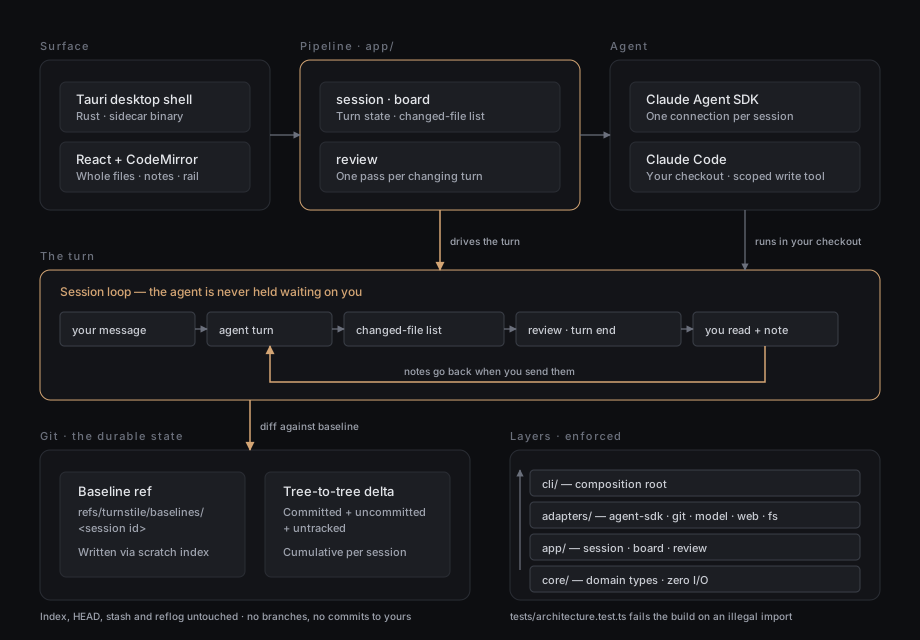
Turnstile isn’t a wrapper around a coding agent — it is the client. It drives Claude Code through the Claude Agent SDK, with no proxy process in between, and runs it directly in the checkout you launched from.
The codebase is ports and adapters in a strict downward stack: core/ holds
domain types, chunking, the risk bar, notes and around two dozen port interfaces
with zero I/O; app/ is the pipeline — session, board, review — written against
those ports only; adapters/ implements them one concern at a time
(agent-sdk, git, model, web, fs, otel), never importing a sibling;
cli/ is the composition root that builds the adapters and wires them together.
The part I care about is that the boundaries are enforced, not documented.
tests/architecture.test.ts parses every relative import under src/, walks the
real graph, and fails the build on an illegal edge — naming it. Seven invariants,
including that core may not contain a filesystem call, a spawn, or a fetch at
all. Layering that lives only in a README rots on the first deadline; this makes
it a property of the codebase instead of an intention.
The UI is a real React app bundled by Bun itself — no Vite, no separate build
step — and embedded into the binary by bun build --compile. Tauri 2 wraps that
binary as a desktop app, carrying it as a sidecar.
Key decisions
A baseline in git, not state in the tool
When a session sends its first message, the whole checkout — committed,
uncommitted and untracked alike — is written as a tree and recorded at
refs/turnstile/baselines/<session>. That happens through a scratch index
(GIT_INDEX_FILE pointed at a throwaway file, then read-tree, add -A,
write-tree), so recording it never touches your index, HEAD, stash, reflog or
history.
The changed-file list is then just “every file that differs from the baseline,” which buys three properties for free:
- committed or not — both sides are compared as trees, so the agent committing its own work can’t hide it;
- whoever made it — the agent’s write tool, a shell command, or you editing a file by hand;
- for the whole session — the list is cumulative, so resuming tomorrow shows everything that has changed since it began, notes still attached.
Because the baseline lives in git rather than in Turnstile’s own store, there is nothing to lose or go stale across a restart. Turnstile creates no branches and never commits to yours; what happens to the agent’s work stays your call, with ordinary git.
Non-blocking by construction
Nothing is reverted and nothing is waited on. The list follows every edit as it lands, the review runs when a turn ends, and your notes reach the agent when you send them. A message typed mid-turn doesn’t interrupt — interrupting is how you get half-finished work — it queues and goes as the next turn.
This is the design’s whole shape, and it replaced the opposite one. More on that below.
The reviewer is read-only, and its answer is typed
When a turn ends having changed something, one reviewer run reads every changed file that has no current review. It runs read-only in your checkout and can read, search and run read-only shell commands across the rest of the repository, because whether a change is right usually turns on something outside it: a caller it broke, a test that should exist, the sibling it should have followed.
Its output is structured, never prose. Each finding is where (any file — a
caller the change broke is a finding in the caller, tied back to the change that
broke it), how badly (low, medium, high), and what, in a sentence or
two. An empty list is the expected answer for most changes.
Two details that took iterating to get right:
- Reviews are keyed to file content. A review holds only while the file is exactly as it was reviewed. Edit it any other way — by hand, a checkout, another session — and it reads not reviewed again rather than showing findings about lines that no longer exist.
- It waits for the turn to end. Reviewing work the agent is still in the middle of means reviewing something about to change, and each review is a whole agent run. A turn that changed nothing isn’t reviewed at all.
A risk bar keeps the reviewer off what it can’t help with — prose, formatting-only edits, comment-only changes, mechanical renames, generated and vendored paths — with one deliberate exception: indentation-significant languages are checked anyway, because reindenting Python or YAML is a behavior change made entirely of whitespace.
Questions go to a different, cheaper model
Notes ask for a change. The other half of reading someone else’s work is wanting to know what something does — and the moment you want to ask is usually mid-turn, exactly when the agent is in no position to answer. So selecting code and asking a question routes to a separate small model, with read-only tools and nothing to write with. Answers appear as cards set into the file under the lines they’re about.
It deliberately doesn’t spend the agent’s context window on a question that isn’t the work, and it keeps nothing: if an answer is worth acting on, you write it as a note, which is the thing that persists and reaches the agent.
The permission default is inverted on purpose
The agent’s native edit and write tools are disallowed outright — a single scoped
tool is the only path to a file’s contents, and only inside the repository.
Everything else auto-approves, which looks backwards until you say it out loud:
prompting for every git status would train you to click through prompts, which
is the exact drift the tool exists to fight. sudo is denied unconditionally,
and regex deny-patterns cover anything else you want stopped.
Plan mode is the one place that bias flips — anything beyond reading stops for you, because plan mode has no review behind it to catch what slipped past.
Telemetry that joins both sides of the session
Turnstile and the agent both export OpenTelemetry, and they meet in the backend rather than in Turnstile — correlated on a session ID rather than nested, because the SDK holds one long-lived connection per session and nesting would hang every turn of a multi-hour session off a single span. A provisioned Grafana stack ships with it, so one dashboard shows the agent’s cost and tokens next to review outcomes, finding severities, and editor keystroke latency measured in the browser where the keystroke actually lands.
Nothing you write or say is exported — durations, counts, paths, model and tool names, not prompts or file contents.
Rebuilding it twice
The most useful thing I can say about this project is that its history is mostly a record of deleting its own designs.
It started as a blocking gate. After every turn the agent waited until you approved or sent back each change, with a review ledger, per-change verdicts and board states to track it all. It worked, and it was wrong: holding the agent hostage to your reading speed makes the reading feel like a toll, and a toll is something you learn to pay quickly. The whole mechanism came out — gate, ledger, verdicts and all — and became the non-blocking design above.
Then the reviewer itself was rebuilt. The first version judged each changed
file against rules I maintained outside the checkout, one file per rule. Two
things were wrong with it: coding agents already carry most of what those rules
encode, in CLAUDE.md and skills, so the rules were duplicated effort — and a
file no rule happened to govern was never reviewed at all. Holding the change to
the repository’s own stated conventions removes both problems and the
maintenance burden with them.
The counterpart is a design I wrote down and then declined to build: reviewing each file in its own subagent and worktree. The decision record works a concrete failure case (feedback written while reading one file that actually targets its sibling), identifies the three subsystems that design would need — detection, liveness, cascade — and concludes that building them means reconstructing, in orchestration code, what one shared agent conversation already gives you for free. It then finds that the real grievance underneath the proposal was latency, checks the existing code, discovers the concern already satisfied, and ends with one line: No code changed as a result of this.
Writing down the thing you chose not to build is the cheapest engineering artifact there is, and the one I reach for most.
Stack
Runtime and build: Bun as runner, bundler and test runner, compiling to a
single binary with the React UI embedded; TypeScript throughout; Rust for the
Tauri 2 desktop shell.
Agent: Claude Code driven directly through the Claude Agent SDK, with a
second read-only run as the reviewer.
Domain: ports and adapters over ~two dozen interfaces, with the import graph
enforced by a test; Zod for config and tool schemas.
UI: React 19 with CodeMirror 6 — whole-file reading with change decorations,
gutter drag for notes, inline finding and answer cards, a risk-sorted rail and a
project tree.
Git: plumbing only — scratch-index tree writes, baseline refs, tree-to-tree
deltas, parsed patches rendered rather than git diff output dumped.
Ask path: Vercel AI SDK over OpenRouter, read-only, on a small model.
Observability: OpenTelemetry traces and metrics over OTLP, with a compose’d
Grafana / Tempo / Prometheus / Loki stack and a provisioned dashboard.
Tooling: Biome for lint and format, Knip for dead code, bun test.
Impact
Turnstile is the project where I stopped treating an AI coding tool as a thing that produces code and started treating it as a thing that produces reading work — and designed for the human side of that exchange. The patterns I took from it show up in everything I build with agents now: put the durable state in the system that already owns it (git) rather than in your own store, keep the model’s output narrow and typed instead of letting it write prose you’ll skim, invert a convenience default when the convenience is what’s harming you, and enforce architecture with a test rather than a paragraph.
It’s about 17,000 lines of TypeScript against roughly 14,000 lines of tests — around 950 cases mirroring the source tree — and the entire suite runs with no network and no API key, because every model call sits behind a port and the reviewer is tested against a mock model. A fake-session simulator boots the real server against a hand-built session, so the interface can be worked on with no agent, no repository and no model call at all; every screenshot in the project’s README was taken from it.
Source is on GitHub at github.com/willredington/turnstile — built from source, macOS for now.